 US: temporary delays — postal services aligning new import rules,
  Europe: 1–2 weeks, 🌍 Worldwide: 1–4 weeks ✈️
Loading...
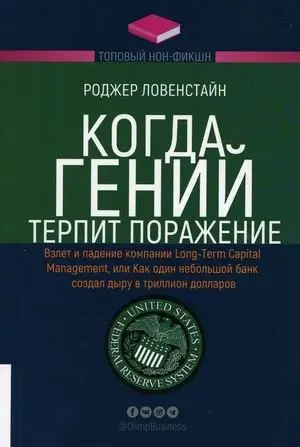
By Ловенстайн Роджер
Ловенстайн Роджер, 2021, серия «Топовый нон-фикшн»
Книга Роджера Ловенстайна «Когда гений терпит поражение» рассказывает историю взлета и падения хедж-фонда Long-Term Capital Management (LTCM). В центре повествования — группа ученых и нобелевских лауреатов, попытавшихся применить математические модели и «закон больших чисел» для получения прибыли на рынке облигаций. Книга исследует, как самоуверенность, сложность финансовых инструментов и недооценка рыночных рисков привели к краху, едва не вызвавшему глобальный финансовый кризис.
Автор анализирует причины, по которым сложные алгоритмы, разработанные гениями, оказались неспособны предвидеть и предотвратить катастрофу. Особое внимание уделяется роли человеческого фактора, психологии трейдеров и непредсказуемости рыночных настроений. Отдельно рассматривается влияние российского дефолта 1998 года на кризис LTCM, ставший катализатором краха.
Roger Lowenstein, 2021, Top Non-Fiction Series
Roger Lowenstein's "When Genius Failed" tells the story of the rise and fall of the hedge fund Long-Term Capital Management (LTCM). The narrative centers on a group of scientists and Nobel laureates who attempted to apply mathematical models and the "law of large numbers" to profit from the bond market. The book explores how overconfidence, the complexity of financial instruments, and the underestimation of market risks led to a collapse that nearly triggered a global financial crisis.
The author analyzes the reasons why complex algorithms developed by geniuses were unable to foresee and prevent the catastrophe. Particular attention is paid to the role of the human factor, the psychology of traders, and the unpredictability of market sentiment. The impact of the 1998 Russian default on the LTCM crisis, which became a catalyst for the collapse, is also examined.